The Stop, Drop & Roll Sleep Command
The Stop, Drop and Roll is a sleep commands to quickly put your body to sleep while remaining consciously aware. It opens the gateway to a lucid dream.
In the last lesson we found that sleep paralysis is most likely when you wake up and fall asleep again without moving at all. So to do that you need a way to fall asleep quickly and reliably. Combined with reality checking, this technique ensures stable lucid dreams. The question is, how do you do that?
Mind Body Independence
The key is in the principle of "mind-body independence".
Mind-body independence means that your mind and body never know precisely what the other is doing. For instance, your body is growing hair, transcribing DNA, digesting food, making blood cells and regenerating tissue. Your mind is mostly unaware of all these. If you had to think about each one you'd never get anything else done. This is mind-body independence.
Mind-body independence also works the other way. When you mind falls asleep your body never really knows completely for sure what happened and if your mind is really asleep or not.
So how does your body know when to enter sleep paralysis?
The key is that even though the mind and body act independently, they still communicate using a language. By learning the words in this language you can talk to your body biologically and make it fall asleep when you want it to.
Your First Word in This Language
Your first 'word' in this biological language is the "roll over signal".
When your body has been very still and relaxed for a long period, your body starts to wonder if maybe your mind has fallen asleep. It would be a very serious mistake if the body went to sleep too early, so the body sends a test signal to the mind. This test signal feels like a strong urge to roll over.
If the mind is asleep, then it does not respond and the body decides it's time to shut down.
If the mind is awake it will respond to the urge to roll over and you'll move. Then the body knows the mind is still awake and does not fall asleep.
So this a major mistake that you need to avoid: never respond to the body's roll over signal because it sends a message to stay awake rather than fall asleep. This can be difficult because the signal can become so strong that it's actually painful.
So the question is: what can you do get past this?
The 4 Types of Roll Over Signals
There are four types of roll over signals you'll encounter.
- Fast Relax - This happens when you relax quickly and deeply and the body decides to just go ahead and paralyze without sending much of a roll over signal, if any. This is a good case to have because it happens quickly.
- Slow Relax - This is the opposite case. If you're tense but stay still long enough and if the body is tired enough, the roll over signal builds and builds until it becomes very painful and extremely hard to ignore. However, if you're too tense the body won't paralyze no matter how long you've been still. This is called a "signal swell".
- Urge Surge - The third type is called an "urge surge" which is a very useful case. In an urge surge, the body sends out a strong signal out of nowhere. If you're able to resist the signal for three or four seconds the body ends the surge and paralysis all at once. If you're not relaxed enough, this will probably result in only partial sleep paralysis which is not ideal.
- The Quick Switch Roll Signal - If waking sleep paralysis is the holy grail for new out-of-body explorers, then the quick switch signal is the holy grail of urge surges. It happens quickly and rewards you with nice and deep sleep paralysis almost instantly. It's an unmistakable feeling.
The Two Cases That Cause a Quick Switch Signal
The quick switch happens in one of two cases:
First, when the body is really tired and wants to go to sleep immediately.
Second, when the body was very recently asleep and is deeply relaxed.
In order to make those cases more likely you need a way to bring on the roll over signal as fast as possible.
So how do you do that? The trick is to use the right body position.
Body Position is Key
The body position that brings on the roll signal faster than any other position is to simply lay flat on your back with your arms at your side. In yoga this is called the corpse pose.

When you lay with your arms at your side you will probably tempted to place your hands on your stomach or cross your ankles. This is a veiled form of the roll over signal.
If you get that sensation it means you're on the right track, just make sure not to give in to it. Keep your arms at your side and your ankles slightly separated.
Using this simple bit of information we can eradicate the single biggest cause of insomnia: the toss and turn syndrome.
Tossing and Turning Syndrome
When you toss and turn in bed, what you're doing is resetting your body's internal sleep timer each time you roll over.
The body is trying to go to sleep by sending you a roll-over test signal but you keep telling it not to sleep when you move. So you end up stuck in a toss and turn loop and never get to sleep. This results in insomnia.
So, is that all there is to it? Just lay there?
Well, not quite.
There are a few things you can do actively to speed things up and tell your body to fall asleep faster.
3 Body Positions
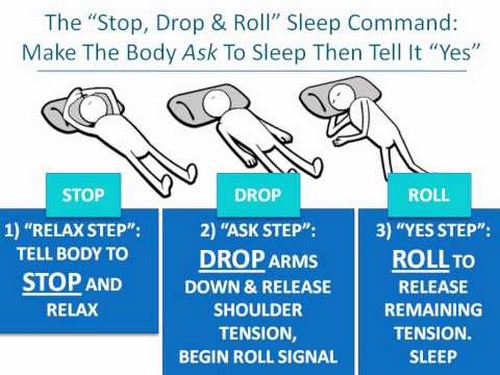
What we're going to do is add a couple of other body positions before and after the corpse pose, so it's part of a series.
- The first position is to lay with your hands above your head.
- The second position is the corpse pose.
- The third position is where you roll over and then fall asleep.
We choose these positions very carefully so that when you move from one step to the next you release the maximum amount of tension possible.
How The "Stop, Drop And Roll" Releases Tension in Chunks
Instead of haphazardly releasing small amounts of tension by tossing and turning over and over, you'll release all your physical tension in exactly two calculated big chunks. Here's what is happening at each step.
- "Stop" - The Relax Step: Have your arms above your head and relax as deeply as you can. Once you feel you've relaxed as far as you can, drop your arms down to your side to release all the shoulder tension that you couldn't get rid of from just laying there. This is the purpose of the first body position - to get rid of shoulder tension all at once.
- "Drop" - The Ask Step: When you drop your arms down to your side and relax, your body will seriously start to consider that maybe the mind is asking it to go to sleep. This position will make you want to roll over. The stronger the roll over signal, the more the body is asking for permission to sleep. When you get to a point where it feels like it's plateaued, slowly roll over.
- "Roll" - The Yes Step: In this step you'll tell your body, "yes it's time to sleep." Simply roll over and then don't move until you're asleep.
The Roll Over Signal Changes Depending on Your Position
The sneaky thing is that the roll over signal changes based on how you're laying - and that may trick you into moving.
On your back, the roll over signal tends to center in your chest.
However, on your side, the roll over signal tends to make you want to move your legs.
Don't fall for that! Don't bend them or straighten them or anything. Keep your legs perfectly still. The urge to move your legs is actually a disguised form of the roll over signal and you must resist it at all costs.
The Best Body Position for Healthy Sleep
Here's the best final body position that's the healthiest for your back according to researchers at the University of Cleveland.
You want to lay on your side so your neck and spine are neutral and relaxed. Bend your hips and knees a bit to lower pressure on your spine. To relieve sciatic nerve strain, put a pillow between your knees.
Sleeping on your stomach is not recommended because it puts your back in an odd position.
A Bonus Secret to Build up The Roll Over Signal
I have one last very powerful trick in reserve that you can use when you have a really hard time falling asleep.
The key is to build up a super strong roll over signal before even getting into bed. Rather than trying to fall asleep in your bed, lay down on the floor next to your bed on your back and relax.
Admittedly, this is unpleasant. But it works. After forcing yourself to lay there perfectly still for 10 or 15 minutes, when you finally allow yourself back into bed your body will be so grateful that it will grab the chance to fall asleep as quickly as it can.
In extreme cases you can even lay on an uncarpeted floor such as in your kitchen, which will build up the roll signal very quickly.
In the next lesson we'll cover 5 more powerful sleep commands you can use to trick your body to fall asleep while you keep your mind awake to have OBEs.
 About The Guest Author
Nick Newport is the author of Lucidology, a website that teaches how to have lucid dreams and out of body experiences from a waking state.