How to Stop Sleep Paralysis - and Transform it into a Lucid Dream | World of Lucid Dreaming
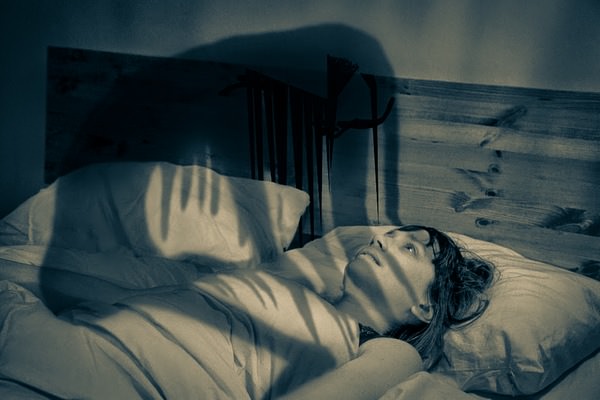
So here's a quirky little nighttime oddity that can strike terror into your soul.
Sleep paralysis. It's the mechanism that stops you from acting out your dreams. It happens to you every single time you go to sleep, and you've probably never even been aware of it. Interestingly, many people mistake sleep paralysis for false awakenings, but they're different experiences entirely.
There's a lot to say about sleep paralysis. One the one hand, it's a very normal bodily process. One the other, it can be a terrifying sleep disorder. And on the third hand (yes, that's three hands now) it's the gateway to the lucid dream world. It covers quite the spectrum of emotions.
So, what causes you to become aware of sleep paralysis? What should you do to avoid triggering the horrific hallucinations associated with it? And how might you harness this state in order to enter a lucid dream? The answers involve understanding wake-induced lucid dreams and the psychology behind the fear response.
What Causes Sleep Paralysis?
The basic cause of sleep paralysis is REM atonia:
- REM stands for Rapid Eye Movement (the sleep phase linked with dreaming)
- Atonia means lack of muscle tension
REM atonia is essential for healthy sleep, else you'd wreak havoc in your neighborhood by acting our your dreams on a nightly basis. This is no good for you, and no good for your neighbors.
As you fall asleep each night, the electrical nerve impulses are cut off between your muscles and your brain. Your brain can still tell your body to do stuff (such as run away from Saruman's dark army in yet another orc-fueled nightmare) but your body won't respond.
So far, so good. But what happens if you wake up and the REM atonia remains in place, albeit only for a few seconds? This is when we trip into the territory of sleep paralysis.

Do orcs dream? Yes, they dream of you. Running away in terror.
You can become aware of sleep paralysis when:
- you're falling asleep (during specific types of lucid dream induction)
- after you've woken up (frequently, when you have a sleep disorder)
The natural reaction to waking up paralyzed is fear. Lots and lots of fear.
Unfortunately, in this borderland sleep state, it prompts the half-dreaming mind to conjure up nightmarish images to "explain" what is happening.
A vivid hallucination can ensue, featuring the sensation of being fully paralyzed while a baddie enters your bedroom and crushes your chest or tries to pull you out of bed. Sometimes the presence may just stand and observe while you float out of bed, as if caught in a tractor beam.
Sleep paralysis doesn't always invoke hallucinations, but if it does, it's common to see witches, ghosts, shadow people, aliens, angels, fairies and even cartoon characters. More in this in a moment.
How common is sleep paralysis? Estimates vary, but it's likely you'll run into sleep paralysis at least once in your life. For those who experience it nightly, it's classed as a sleep disorder.
It's more likely to occur if you're under stress or have disturbed sleep cycles due to shift work, narcolepsy, sleep deprivation, jet lag, and other sleep disorders.
If It's Just a Dream - Why So Real?
If sleep paralysis is just a dream, then why does it feel so real?
Some of the effects ARE real. This state is a merger of waking consciousness and the dream world. It's a bizarre mind trick. Here's what I've found through research and my personal experiences:
-
Footsteps thumping towards the bed are a
distortion of the sound of your own heartbeat, pounding in your
chest due to the adrenaline.
-
Hearing an imaginary assailant
breathing unnaturally is common too. It's thought
to be the sound of your own gasps for breath in this panicked
state.
-
The feeling of your body being paralyzed is very
real, too. This may make your chest feel tight, but remember you
can still breathe normally. (You usually breathe while you're
asleep, right?)
-
You may find that your attacker
compresses your chest. Again, this is your
half-asleep brain rationalizing your limited breathing.
Thankfully, any evil entities you see during sleep paralysis are
not real. If you are hallucinating a bad guy in your bedroom,
remember: it's an illusion. A kind of waking nightmare.
- You may feel like you're being pulled or are floating out of bed. This reflects your mind's tenuous grip on real-world bodily sensations. When you can't feel your body, the mind starts to invent feelings for it. And usually, they're pretty floaty (see the effects of lucid dream pills). This floatiness is perfectly normal during so-called out-of-body experiences, which are actually better defined as types of lucid dreams (see also: astral projection vs lucid dreaming). Such experience always occur during this borderland sleep state.
Sleep Paralysis in Other Cultures
This is not a new condition. Sleep paralysis, under various guises, has existed in folklore from many different cultures for centuries - perhaps millennia.
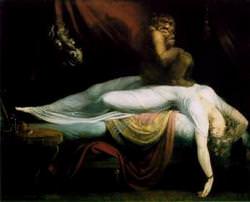
In Japan, they call it "kanashibar". In Newfoundland, it's known as "the old hag" who visits you in the night. In China, they know it as "ghost oppression". Even artists have depicted this ghoulish night-time disorder: see The Nightmare by John Henry Fuseli.
It's no surprise that native folklore shapes the nature of sleep paralysis hallucinations.
In the US, it was only after flying saucers were popularized that people reported vivid alien abduction experiences, where aliens paralyzed and probed them in their beds at night.
In Mexico, more than 90% of teenagers know the phrase "a dead body climbed on top of me" to describe the nightmare entity. And in African culture, it's known as "the devil riding your back" where demons have sex with people in their sleep.
This all tells us that sleep paralysis is a common human condition. What's more, the hallucinations are shaped by your expectations.
How to Stop Sleep Paralysis
Now I'm going to show you how to stop sleep paralysis in its tracks - or to evolve it into a lucid dream scenario. It's good to have both of these tricks up your sleeve.
If you're a chronic sufferer of sleep paralysis, then prevention is going to be better than a cure. You're likely already predisposed to sleep paralysis so try to avoid anything which messes with your sleep cycles. We're talking nightshift work, overtiredness, jet lag and extreme sleep deprivation.
It's also really important to avoid stress and anxiety, particularly before sleep. If you're suffering from chronic stress, attend to that and your sleep paralysis could go away on its own.
If you wake up in the night and already in the throes of sleep paralysis, here are some tips to cut it short:
- Relax your body into the paralysis. Don't fight it forcefully, as this creates panic and increases the chance of having scary hallucinations.
- Try to gently wiggle your fingers and toes. These tiny movements will eventually tell your brain that your body is awake and to stop the atonia.
- Try to move your eyes by blinking and looking around the room. Again, the goal is to establish waking-like movements to fully awaken your brain and body together.
- Try to move your lips and facial muscles.
- Focus on breathing as slowly and deeply as you can. If your breathing feels restricted, remember that you have been breathing fine like this while asleep for hours.
- Maintain a calm and positive mental state. Focus on relaxing thoughts. Imagine a beach in the sun, a million miles away from the darkness of your bedroom. Sing an upbeat song in your mind.
Maintain these goals for the duration of the sleep paralysis and stay on top of any fear.
Sometimes you will find it wears off in a few seconds. Other times it may appear to get the better of you - but stay strong and focus on those tiny movements. You own this.
As soon as your brain receives adequate signals that you are awake, it will shutdown the REM atonia. You will quickly be able to move your whole body again, and the hallucinations will disappear in an instant.
If sleep paralysis is something that bothers you, consider learning how to lucid dream. These skills can help you turn what is currently a problem into a way of controling your own internal dream worlds!
Speaking of which...
Transforming Sleep Paralysis into Lucid Dreams
Uniquely, this borderland sleep state acts like a gateway to the world of conscious dream control.
You're already halfway to a lucid dream because your body is, technically, asleep while your mind is consciously aware. These are also hallmarks of a lucid dream. (Performing reality checks during this state can confirm that you're dreaming and help you transition fully.)
The only difference?
You lack full immersion into dream imagery. In sleep paralysis, your eyes are open (or part open) and you're "stuck" in your real physical body as opposed to frolicking through a meadow in your limitless dream body.
So the answer is to focus your awareness on re-entering that dream space.
On having your brain coordinate movements with a dream body and experiencing that internally generated dream world.
The actual process of transforming sleep paralysis into a lucid dream is simple - but does require some detailed explanation if we're looking at all the possibilities.
The good thing is, once you've learned how, you can gain control over the dream and instantly direct it away from anything fearful and toward any beautiful dream scene your imagination can conjur!
Read our detailed tutorials on Wake Induced Lucid Dreams (WILDs) as well as Out of Body Experiences (OBEs) to get a complete understanding of this process.
Or, if you’d like to learn in 10 minute lessons each day for a fortnight, check out 10 Steps To Lucid Dreams.
Finally, remember that sleep paralysis, though sometimes startling, can't hurt you. It's a vivid experience of the mind and you can put it to good use. I know I do.
Sleep paralysis comes up constantly in our forum archive. The sleep disorders board collects members’ first-hand accounts of paralysis episodes, night terrors, and the techniques they used to stay calm through them.
If sleep paralysis has you wondering about the safety of dream work in general, our guide on the risks of lucid dreaming puts it all in perspective.
And if it's the terrifying figure you encountered that's playing on your mind, we explain exactly what sleep paralysis demons are and why the brain conjures them.

About The Author
Chris Hammond writes about lucid dreaming, awareness, the nature of consciousness, and cosmic existence. See him in action at The World of Lucid Dreaming Academy.