Binaural Beats for Lucid Dreaming
A closer look at binaural beats for lucid dreaming. How effective are binaural beats? What do they sound like? How do they promote relaxation?
Binaural beats were discovered in 1839 by a German scientist named Heinrich Dove. Ever since, they have been touted as one of the most popular forms of brainwave entrainment, along with monaural beats and isochronic tones.
Listening to binaural beats can quickly create states of quiet meditation, which is excellent practice for lucid dream induction. What's more, they don't require any stringent mental focus - only your willingness to lie quietly and relax.
What Are Binaural Beats?
"Slow modulations called binaural beats are perceived when tones of different frequency are presented separately to each ear. The sensation may show how certain sounds are processed in the brain.
If two tuning forks of slightly different pitch are struck simultaneously, the resulting sound waxes and wanes periodically. The modulations are referred to as beats; their frequency is equal to the difference between the frequencies of the two original tones.
Binaural beats have been widely regarded as a mere curiosity. A recent textbook on hearing does not mention them at all. Yet the measurement of binaural beats can explain the processes by which sounds are located -- a crucial aspect of perception. It is possible that hormonally induced physiological behavior changes may be made apparent by measuring the binaural-beat spectrum."
~ Gerald Oster, Scientific American, October 1973
How Do Binaural Beats Work?
The human brain treads many different frequencies every day, each depicting your current level of consciousness.
For instance, the THETA brainwave frequency occurs during states of still alertness, light sleep and dreaming. It is marked by 3-6 cycles (Hz) per second.
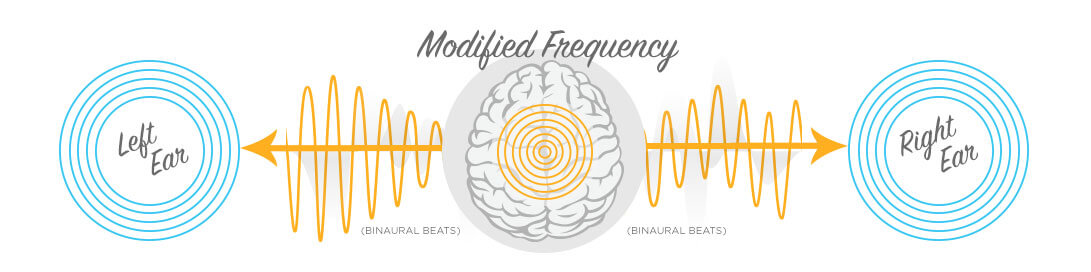
It is possible to entrain this frequency through sound. But we can't simply play a 6 Hz frequency in the ear and expect the brain to respond, because we can't even detect sounds that low. The solution with binaural beats is to play two separate frequencies into each ear (eg, 130Hz in the left / 136Hz in the right).
The brain compensates for the difference in frequencies heard in the right and left ear, creating an internal frequency of 6 Hz, and thereby entraining a THETA operating state. It then produces a frequency following response. Because the effect is produced within the brain it is critical to wear headphones.
What Are The Effects of Binaural Beats?
Studies have produced a general consensus on what types of effects you may feel while listening to binaural beats. I have experienced various phenomena usually associated with relaxation and mediation:
- Physical and mental relaxation
- Increasing focus on the inner world
- Visual hypnagogia (seeing colors, patterns and shapes)
- Audial hypnagogia (hearing voices and snippets of conversation)
- Out-of-body phenomena (floating limbs and bodily dissociation)
- Conscious awareness of emerging dream scenes
These effects are the result of listening to binaural beats as well as a conscious effort to meditate. With practice this helps prepare my mind for more lucid dreams.
Binaural Beats for Lucid Dreaming
If you're interesting in checking out binaural beats, there are plenty available for free on YouTube. However, I have been told by experts in the field that the 'lossy' audio format used by YouTube means that these tracks (whilst nice to listen to) don't deliver a technically true binaural beat.
If you are after the real deal, check out Gnuaral. It's 100% free and you can create your own completely pure beats.
Going deep into a trance-like state of meditation, you'll enter a state where it seems as if your mind slows almost to the point of sleep, but not quite.
This is one of the more elusive and extraordinary realms to consciously explore. It is also sometimes called the twilight state, which you normally only experience fleetingly when drifting off to sleep.
Your receptivity will be heightened and you'll be able to access knowledge and information that normally lies beyond your conscious awareness. As flashes of vivid imagery dance before your mind's eye, you may feel a floating sensation as your mind disconnects from your body and enters a "mind awake / body asleep" state.
In this deeply relaxed state, don't be surprised to receive sudden insights or inspiration. You may see or hear unexpected stimuli pushing into your awareness from the dream world. Here, you can also plant the seeds to question your reality and become lucid in your dreams, as well as practicing a Wake Induced Lucid Dream.


About The Author
Rebecca Casale is a lucid dreamer and a science writer with a special interest in biology and the brain. She is the founder of World of Lucid Dreaming and Science Me.