

The Hypnagogic State: How to Have Lucid Dreams Using Hypnagogia

The hypnagogic state is a peculiar sensory experience that marks the onset of sleep. You will almost certainly recognize it, even if you've never paid attention or thought much about it before.
This intriguing mildly hallucinogenic state can be used to have wake induced lucid dreams, by remaining aware while they lull you to restfulness. You can even shape the visions at will, leading directly to your lucid dreamscape.
"Only when I am on the brink of sleep, with the consciousness that I am so..."
~ Edgar Allan Poe
What is The Hypnagogic State?
Hypnagogia can include a mesmerizing array of visions, sounds, bodily sensations and insights as you sail through the borderland sleep-wake state.
It usually begins with phosphenes - vague blobs of purple and greens, which appear slightly luminescent in the darkness of your closed eyelids.
In time, these blobs evolve into more interesting geometric imagery, and eventually familiar faces and landscapes. The deeper you go without falling asleep, the more likely you are to hallucinate voices and other sounds - sometimes even music. This is the start of the dream state.
As the increasingly complex patterns flow across your field of vision, you feel drawn into the hypnotic hypnagogic state. This can be manipulated at will.
What many people don't realize is that the imagery can lead directly to lucid dreams.
The hypnagogic state is by no means limited to visuals.
Auditory hypnagogia range from household noises like phones ringing, to music, to voices calling your name, to the loud buzzing noise associated with the onset of out of body experiences. Hypnagogia can even cause you to feel as if you are floating outside of your body.
What Causes Hypnagogia?
While some people consider hypnagogia to be meaningless activity of the brain - a way of clearing out unwanted junk - others believe it has more value.
Like lucid dreams, hypnagogia can be consciously guided and interpreted as it happens, forging a two-way communication with the unconscious mind.
Scientists have linked the hypnagogic state with several stages of sleep: NREM sleep, pre-sleep alpha waves, REM sleep and relaxed wakefulness.
There is a theory that regular meditation can enable you to develop a skill to freeze the hypnagogic process at later and later stages. From personal experience, I find that hypnagogia can be helpful in judging the depth - and deepening - the meditative state required for wake-induced lucid dreams.
Hypnagogic Exercise #1
Although it is more readily seen before sleep, you can observe some mild hypnagogia right now, while mentally alert and aware.
Close your eyes and cup your palms over your eye sockets (without actually touching your eyeballs). Focus on the middle distance. What do you see?
At first there may be an afterimage from the glare of the screen, but then you should see some faint visuals in the darkness like holographic wallpaper lining your eyelids.
They will typically appear as static, geometric patterns which intensify a little when you direct your focus towards them.
For more exercises like this see How to Visualize.
Using Hypnagogia to Have Lucid Dreams
Observing and interacting with the hypnagogic state as you drift to sleep is one way of entering a lucid dream on demand.
The most powerful technique is known as a Wake Induced Lucid Dream, which in some circles is known as the Hypnagogic Induction Technique because hypnagogia plays such an important role.

Hypnagogic Exercise #2
To begin, lay quietly in a darkened room as if you are going to sleep. (An even better starting point is when you wake up in the night, already relaxed, preferably after 4-6 hours of sleep.)
Allow your eyes to close naturally and observe the darkness. The goal is to relax deeply and convince your body that you are going to sleep. The challenge, however, is to quiet your mind just enough (no mind chatter) while holding onto a strand of awareness.
Hypnagogia often begins with amorphous blobs of color slowly moving through my field of vision. Then they shape up into more interesting patterns. I then visualize new forms for my hypnagogia to take by willing the visuals to form shapes with increasing complexity. It can help if you mentally say things like: "I'm going to see a square now" and then actively look for it.
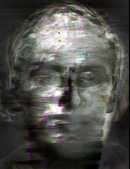 With practice, you will learn how to evolve these moving shapes
into people and places, which dictates the nature of your upcoming
lucid dream.
With practice, you will learn how to evolve these moving shapes
into people and places, which dictates the nature of your upcoming
lucid dream.
At some point, your dreaming mind takes over, introducing new imagery from beyond your field of vision. I'd liken this to recalling a memory. The sensation and emotions and visual recall come to mind, from somewhere beyond the projected imagery.
And so the lucid dream begins...
If you remain aware, you'll find yourself in a lucid dream. To be a true WILD, there is no lapse in consciousness. (You may lose awareness for a few moments, then remember you are dreaming. This is more aligned with a Dream Initiated Lucid Dream or DILD.)
Depending on your state of mind when the hypnagogic state begins, it can take as little as a few seconds to turn the visuals into a lucid dream. Or it can take 20-30 minutes.
After this length of time, it is a judgment call whether to keep going. If you are starting to feel restless, then it's time to stop. If you feel dreamy and sleepy, by all means keep going...
The hypnagogic induction technique is a compelling way to explore the realm between consciousness and sleep. You will discover deep relaxation, trippy visuals, clarity of thought, stress-relief and new insights.
Some people find it difficult to master at first. The hardest part is making the transition from observing the hypnagogia to becoming fully submerged in the dream. However, it is worth practicing because this also serves as a powerful form of meditation, which itself aids lucid dreaming.
Learn More About The Hypnagogic State
I've discussed multiple techniques on this site in which the hypnagogic state plays a role. To learn more, check out:
- Exploring Your Hypnagogia
- How to Visualize
- Brainwave Entrainment Meditation
- Wake Induced Lucid Dreams
- Out of Body Experiences

About The Author
Rebecca Casale is a lucid dreamer and a science writer with a special interest in biology and the brain. She is the founder of World of Lucid Dreaming and Science Me.